

Using Creativity To Navigate Career Changes
Interviewing YouTuber and Substack writer Anna Reich from Beyond the Blueprint


Dear readers,
This week, I have the honor of chatting with , a YouTuber with 10K subscribers and the writer of the Substack newsletter Beyond the Blueprint. We'll be discussing career transitions, setbacks, broken dreams that turn into opportunities, and everything in between.
If you have any questions for Anna, feel free to leave them at the bottom of the article. And if you enjoyed the interview, don’t forget to click on the 💙-shaped button!
May this interview inspire you!

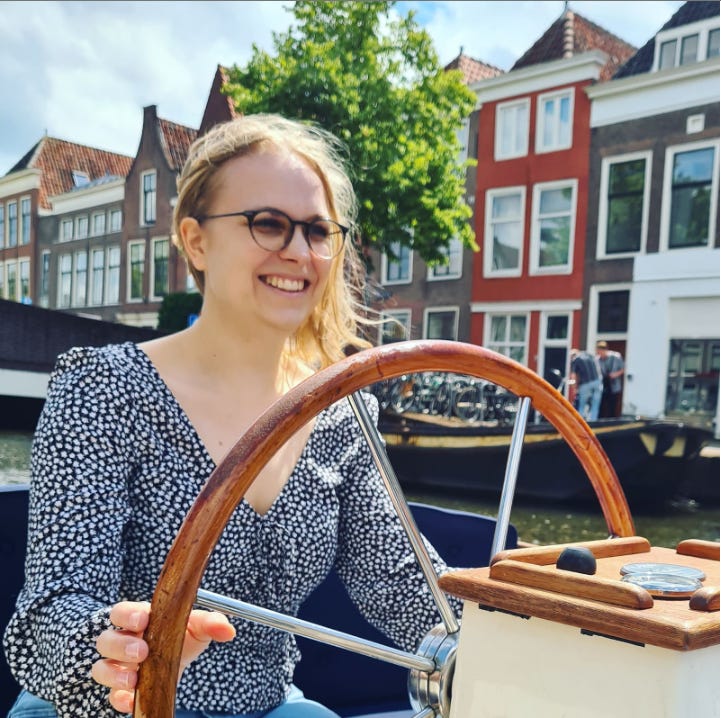
Hi Anna! I’m so happy to be able to interview you today! When I first came across your Substack newsletter Beyond the Blueprint a couple of weeks ago and watched some of your vlogs on your YouTube channel, something immediately clicked. I felt we have similar values and experiences in common, and I couldn’t wait to interview you to share your insights with our readers on changing paths, pivoting, and, why not, coping with setbacks as a young professional. So, thanks for being here!
Thank you, Caterina! I’m ecstatic you asked me to do this interview since I love talking about these topics!
Could you tell us a bit about yourself—what your life and career have looked like up until now, and what inspired you to start your YouTube channel and newsletter?
I grew up in Northern Germany and later moved to Berlin for university, where I chose to study Mechanical Engineering. I based that decision on my interests in math and physics, but it was a pretty random choice, surprising many around me. During my bachelor’s, I spent an exchange semester in Lyon, France, and interned at a consultancy for start-ups and mid-sized companies, which really sparked my interest in entrepreneurship.
For my master’s in Mechanical Engineering, I ended up spending a year in Stockholm, Sweden, which turned into a four-year stay. The pandemic allowed me to complete my master’s degree remotely from Sweden, and I even pursued a second master’s in Entrepreneurship and Innovation Management.
In the final year of my studies, I began working at a Swedish battery scale-up, where I witnessed its exponential growth and contributed significantly to the construction of Sweden's first Gigafactory, helping it evolve from an empty field to a nearly operational facility.
Interestingly, I launched my YouTube channel the same month I began my first full-time job.
I’d wanted to start a channel since I was 15, but I kept putting it off. After finishing my master’s, I realized that there would never be a "perfect" moment when I magically had more time, so I just went for it. My goal was to inspire others to pursue engineering and share what I’d learned along the way. Since then, the channel has grown to 10K subscribers, and it’s been a fulfilling creative outlet for me.
The newsletter started as one of many experiments (I also launched a 10-episode podcast interviewing other engineers) and because I love writing. As a child, I dreamed of becoming an author, frequently writing poems and short stories, and now I’m considering making that dream a reality by writing a book next year.
Starting my YouTube channel broke a sort of mental dam for me—it showed me that I could actually do the things I dreamt of. Now, I’m a bit addicted to making anything I set my mind to come true.
Last year, I felt it was time for a new chapter, both in my career and personal life.
I quit my job without a clear plan, left Sweden, and moved to the Netherlands to finally close the distance in my relationship. I moved in with my boyfriend and his dad and took a six-month sabbatical to focus on learning Dutch, creating YouTube content, and applying to jobs.
It wasn't long before I landed my dream position as a management consultant.
However, the universe had other plans for me.
After six months, I was unexpectedly let go, which was a shock at first, given the positive feedback I’d received. But now, I see it as a blessing in disguise. I’m currently figuring out my next steps and plan to try freelance operations consulting, finally taking the leap to work for myself—a dream I’ve had for years.
I believe what helped me bounce back so quickly from this setback are my personal projects, such as my YouTube channel and Substack newsletter.
They’ve been a consistent source of confidence and proof that I can create cool stuff on my own–something no one can take away from me. When I lost my job, a part of me thought, “Great, now I finally have more time to create!” So that’s what I’ve been doing ever since.
Wow, that's a lot of experience! In your article “Why do we feel so lost in our 20s and 30s?”, you normalize the concept of the ‘quarter-life crisis’—which I feel like I’ve been experiencing for years now(!) I love that you’re addressing this topic because it still feels somewhat taboo. When talking with people around our age, I often get the impression that they have everything figured out. But once we dive deeper into conversation, I realize they often feel just as confused, fearful, or in search of change as I have often felt. Do you think there’s a need to talk more openly about these feelings? Why?
Absolutely, I do! The more openly we discuss these feelings, the more we realize that we're not alone, and that experiencing a 'quarter-life crisis' is completely normal. In fact, wouldn’t it be kind of suspicious if we had everything figured out at this stage of life? Embracing these uncertainties can be incredibly empowering. It allows us to work with reality rather than against it and, for me, the uncertainty is a feature, not a bug.

Life is an unpredictable journey, and while we may start with a map and compass (if we’re lucky), the real adventure begins when we navigate uncharted territories.
It’s also important to recognize how much careers have evolved in recent decades, while the advice we receive has largely remained the same.
We’re often encouraged to pick a major or career path based on subjects we enjoyed in school or a singular passion we’re expected to discover early on. But this approach overlooks the fact that both we and the job market are constantly changing. Many of the jobs that exist today didn’t even exist when our parents were starting their careers, and the same will likely be true for us in the future.
By accepting that our career paths might take unexpected turns and talking about it openly, we can open ourselves up to new opportunities and, hopefully, come up with a better set of advice than we received at the start of our careers.

Talking about career changes, I love how clearly you explain your decision to change your YouTube channel's theme after leaving your engineering career in the video titled “A new direction for my life and this channel”. I think any change, especially when announced publicly, always involves an element of fear.
What would you recommend to someone who is both afraid of change yet deeply desires it? What’s something that helped you embrace change and express it outwardly, rather than fear it?
I was 100% scared that I would lose subscribers, views, and possibly disappoint people. And to some extent, that did happen—I initially lost about 10 subscribers, and my new videos haven’t performed as well. However, my overall views are up, my channel is still growing at the same rate, and now that it’s happened, it doesn’t feel nearly as daunting as I’d imagined. Yes, I need to build a new audience for this content, but that’s also exciting.
What helped me take this step was asking myself, ‘What’s the alternative?’ Would I keep creating content I’m no longer passionate about, inevitably leading to burnout and possibly quitting altogether?
To me, that’s a far greater risk than potentially having a smaller channel that I’m deeply enthusiastic about. I’m convinced that this enthusiasm will allow me to create better content and eventually grow even more than if I’d stuck to a niche I no longer felt connected to.
Finally, I chose to be open about the change because I wanted to attract people who are genuinely excited about these new topics. It’s okay if not everyone likes it—if you try to please everyone, you’ll end up resonating with no one.
It makes so much sense—authenticity is truly key for a creator who doesn’t want to base their work solely on stats. Slightly changing topic: I can tell from your articles that you’re an avid reader! If you had to recommend a book or resource to someone who is changing paths, what would it be? Why?
If I can, I’d love to recommend two books, each offering a unique perspective on navigating life’s transitions.
For those seeking inspiration through someone else’s journey, I’d recommend The Pathless Path by Paul Millerd. It’s about his transition from following the ‘default path’ of working in consulting and getting an MBA to quitting his job and becoming an indie consultant. It’s a powerful reminder that there are many ways to define success. I also joined his Pathless Path Community where I’ve made amazing friends from all over the world who are also carving out their own unique paths. When I lost my job, some of them even congratulated me on the opportunity for a fresh start. That was huge for my confidence!
For a more introspective read, I’d recommend Four Thousand Weeks by Oliver Burkeman. It’s a book about embracing the limitations of time and focusing on what truly matters to you. This book has had a profound impact on me and was instrumental in helping me take control of my life and career. Both of these books have been key influences in my decision to, as I like to say, grab the steering wheel of my life.
Lastly, now that you’re taking a career break, what will you be focusing on? What can our readers expect from your newsletter in particular?
I actually hope this will turn out to be more than just a career break—I see it more as taking a new, very different career step by working for myself.
My main focus will be on building a business around freelance operations consulting, where I plan to leverage my engineering background and passion for business to help companies improve their operations to become more efficient and achieve better flow. I also plan to create dedicated operations content that inspires companies to streamline their processes and unlock their full potential.
I’ll also be continuing with my newsletter and YouTube channel, where I’m committed to talking about overcoming the quarter-life crisis and what it means to take control of your life.
I also plan to share some stories and insights from my experience in consulting and of course real-time updates as I build my new business. I’m really excited to embark on this new adventure and bring my audience along!
That sounds truly amazing, Anna! Thank you so much for being here today. I wish you the best of luck, and I can’t wait to read your upcoming newsletter issues!
Thanks for having me, Caterina! I’m really glad we found each other’s Substacks, and I’m excited to continue this conversation with you and your readers.

Dear readers, I hope you enjoyed this interview with Anna Reich from Beyond the Blueprint. I'd like to leave you with a few reflection pointers:
If you are contemplating or have already made a career-related change in your life, what scares(d) you the most? What do you think would help you feel more secure and confident?
What online or physical resources have you found useful for dealing with change?
Lastly, do you have any questions for Anna about her experiences, YouTube channel, or Substack newsletter?
That’s all from me this week. I’ll see y’all soon!
Yours,
Caterina
 | A guest post by
|
Thanks so much for having me, Caterina!
I feel so honored and had a blast answering your questions ❤️
Thanks Caterina and Anna, enjoyed this interview. Question for Anna: Your newsletter and Youtube etc seem to be things you do tangentially to your "day job" but have you ever thought about making those your primary occupation? In other words become a content creator?